
What Is the Difference Between Vape Flavour, Aroma and Taste?
SEO Title: Vape Flavour vs Aroma vs Taste: What Is the Difference?
Meta Description: Understand vape flavour, aroma and taste, including how e-liquid ingredients, cooling agents, nicotine and device conditions affect sensory perception.
URL Slug: vape-flavour-vs-aroma-vs-taste
Primary Keyword: vape flavour vs taste
Secondary Keywords: vape aroma, e-liquid flavour explained, vape cooling sensation, vape throat sensation, why vape flavour changes
Introduction
When discussing electronic vaping devices, terms such as flavour, aroma and taste are often used to describe the same experience. However, they refer to different sensory processes.
A vape product described as strawberry, grape or tobacco has a flavour profile intended to resemble particular aromas or taste associations. The actual experience depends on the formulation, the aerosol produced by the device and how an individual perceives it.
Understanding these differences can also help explain why a vape may smell fruity but not seem particularly sweet, why an “Ice” flavour can create a cooling sensation, or why a device's flavour may seem different over time.
This guide explains these concepts specifically in the context of electronic vaping aerosols.
1. What Does Flavour Mean in a Vape?
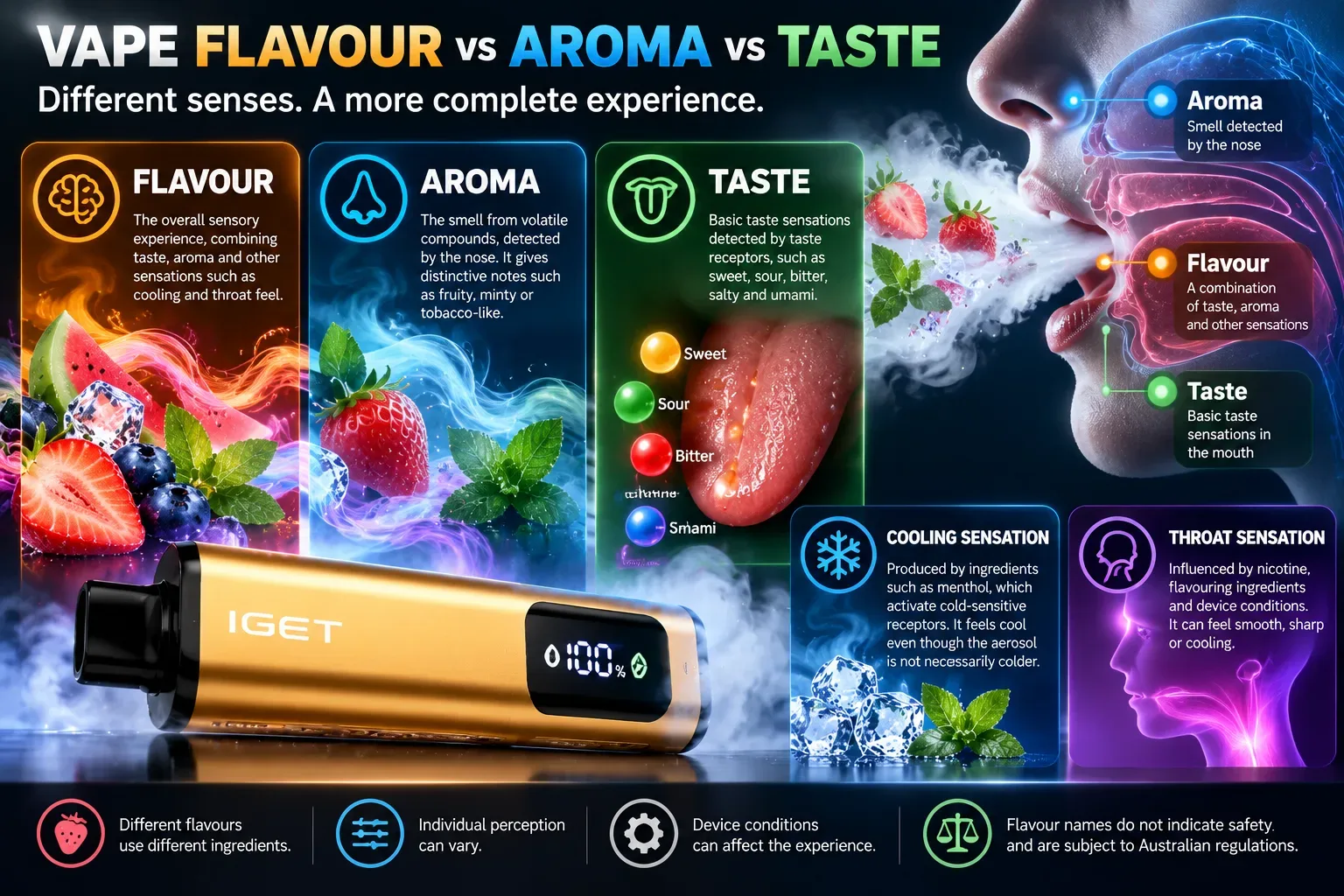
In vaping terminology, flavour generally describes the overall sensory profile associated with the aerosol generated by a device.
This profile may involve several elements:
Aromatic compounds associated with fruit, mint, tobacco or other flavour categories.
Perceived sweetness, bitterness or other taste sensations.
Cooling, tingling or irritating sensations.
The way these sensations combine during exposure.
For example, a product labelled Strawberry Watermelon is named to suggest a combination of strawberry and watermelon flavour characteristics. The label alone does not establish the exact ingredients or guarantee that every person will perceive the same profile.
Similarly, a product described as Grape Ice combines a grape-related flavour concept with an expected cooling sensation. The cooling effect is a separate sensory component rather than a basic taste.
The important distinction is that a flavour name describes an intended sensory identity, not a complete chemical analysis of the product.
2. What Is Vape Aroma?
Aroma refers to the smell associated with volatile compounds.
In electronic vaping devices, flavouring ingredients and other formulation components may contribute to the aromatic characteristics of the generated aerosol.
These compounds interact with olfactory receptors in the nose. The brain interprets the resulting signals as different smells.
For instance, a formulation may be perceived as fruity, floral, woody or tobacco-like because of its aromatic composition.
Aroma and taste are not interchangeable. A substance can have a strong aroma without producing a correspondingly strong basic taste sensation.
It is also important to distinguish the smell of a liquid from the aroma of the resulting aerosol. Heating can change the chemical composition of some ingredients, so the two should not automatically be assumed to smell identical.
The actual aromatic profile of a particular vape product can only be established reliably through appropriate analysis or controlled sensory assessment.
3. What Is Taste in a Vape?
Taste refers to basic sensations detected by taste receptors.
The five commonly recognised basic taste qualities are sweet, sour, salty, bitter and umami.
In the context of vaping, people may describe an aerosol as sweet, bitter or otherwise distinctive. These descriptions are subjective sensory reports and do not necessarily identify the chemicals responsible.
For example, a product may be perceived as sweet because of the interaction between its aroma and the person's sensory expectations. This does not establish that the formulation contains sugar.
Likewise, a bitter or unusual taste does not identify a specific ingredient or prove that a particular component has failed.
Taste should therefore be distinguished from aroma and from other sensations such as cooling or irritation.
4. Vape Flavour vs Aroma vs Taste: Key Differences
| Term | Meaning in vaping discussions | Example |
|---|---|---|
| Flavour | The overall perceived sensory profile | A product described as strawberry-watermelon |
| Aroma | Smell associated with volatile compounds | A fruity or tobacco-like smell |
| Taste | Basic taste sensations | Perceived sweetness or bitterness |
| Cooling sensation | A temperature-related sensory response | A cold feeling associated with some “Ice” formulations |
| Throat sensation | Physical sensation in the throat | Irritation or a cooling feeling |
These categories can overlap during a person's experience, but they describe different mechanisms.
For accurate product descriptions, it is better to identify which sensation is being discussed rather than treating every perception as a flavour characteristic.
5. Why Can Vape Flavours Produce Different Sensations?
Several factors can contribute to differences in the perceived flavour of electronic vaping aerosols.
Flavouring ingredients
Different formulations may contain different combinations and concentrations of flavouring compounds. These differences can change aromatic characteristics and the resulting sensory experience.
However, the flavour name alone does not reveal the complete formulation.
Cooling agents
Some formulations may contain menthol or other cooling agents that interact with sensory receptors associated with coolness.
The resulting sensation does not necessarily mean the aerosol is physically colder.
Cooling should also not be interpreted as evidence of reduced irritation or lower health risk.
Nicotine and other formulation components
Nicotine can contribute to throat irritation. The formulation's other ingredients and their concentrations may also influence the sensations experienced.
A person's description of a product as smooth, harsh or cooling does not establish its nicotine concentration or toxicological properties.
Device operating conditions
Heating-element condition, electrical output and liquid delivery can influence aerosol generation and composition.
Consequently, differences in perceived taste may arise from device conditions as well as formulation differences.
These factors should not be confused with independently verified evidence about a particular product's performance or safety.
6. Why Does Vape Flavour Sometimes Change Over Time?
A change in perceived flavour does not necessarily mean that the product's original formulation has changed.
Several explanations are possible.
Sensory adaptation: Repeated exposure to an aroma can make it seem less noticeable over time.
Changes in device condition: A change in heating-element condition or liquid delivery may affect aerosol generation.
Environmental exposure: Heat and storage conditions can affect some formulations and device components.
Changes in smell perception: Nasal congestion or other temporary changes in smell sensitivity may affect how a flavour is perceived.
Product variation: Manufacturing differences may affect product characteristics, but this requires evidence and cannot be concluded from taste alone.
If a device develops a burnt smell, unusual taste, leakage or excessive heat, stop using it rather than attempting to dismantle or repair a sealed device.
7. Does a Stronger Vape Aroma Mean a Stronger Flavour?
Not necessarily.
A strong aroma may make a particular sensory profile more noticeable, but it does not automatically indicate stronger basic taste sensations.
Aromatic intensity, perceived sweetness, cooling and throat irritation are separate characteristics.
Similarly, a strong smell does not establish a higher nicotine concentration, a greater amount of liquid consumed or a particular level of health risk.
Without verified formulation data and appropriate testing, these characteristics should not be used to infer one another.
8. How Should Vape Flavour Descriptions Be Interpreted?
When reading a vaping product description, it is useful to separate three kinds of information.
First: the descriptive label. A name such as grape, strawberry or tobacco identifies an intended flavour category.
Second: the reported sensory experience. Terms such as sweet, fruity, cool or bitter describe how a person perceives the product.
Third: the verified technical information. Ingredient lists, nicotine specifications and other product details require reliable documentation.
These are not equivalent forms of evidence.
A flavour label cannot independently establish which ingredients are present, how an aerosol will affect every individual or whether a product is safe.
This distinction is particularly important when evaluating technical claims about vaping products.
9. Australian Regulatory Considerations
Australia regulates the supply and advertising of vaping products under strict federal and state or territory requirements.
The Therapeutic Goods Administration's standards restrict permitted flavours for therapeutic vaping substances to mint, menthol and tobacco, alongside unflavoured formulations. Other flavour combinations are not permitted for lawful supply under those standards.
Advertising and promotion of vaping goods are also restricted, subject to applicable legal authorisations and exceptions.
Accordingly, the flavour terminology in this article is provided for technical explanation. It should not be interpreted as a recommendation to use a particular product or as confirmation that a product may lawfully be supplied in Australia.
Businesses publishing vaping-related material for Australian audiences should assess the content and the overall website context against the applicable requirements.
Frequently Asked Questions
What is the difference between vape flavour and vape aroma?
Vape flavour describes the overall perceived sensory profile, while aroma refers specifically to smell. Flavour perception can involve aroma, basic taste and other physical sensations.
Is vape flavour the same as taste?
No. Taste refers to basic taste sensations, whereas flavour is a broader sensory experience that also involves smell and other sensory inputs.
Why can a vape smell fruity but not taste sweet?
Aromatic compounds can create a fruity smell without producing a strong sweetness sensation. Aroma and basic taste are related but distinct.
Why can an “Ice” flavour feel cold?
Cooling agents may activate sensory receptors associated with coolness. The sensation does not necessarily indicate a lower aerosol temperature.
Can device condition affect vape flavour?
Yes. Changes in heating conditions or liquid delivery can affect aerosol generation and may alter the perceived flavour. A taste change alone cannot identify the cause.
Does a stronger aroma mean more nicotine?
No. Aromatic intensity cannot reliably establish nicotine concentration. Product specifications require appropriate documentation.
Does a smoother vape sensation mean a product is safer?
No. Sensory smoothness does not establish the chemical composition of an aerosol or its health risks.
Conclusion
Flavour, aroma and taste describe different aspects of the sensory experience associated with electronic vaping aerosols.
Flavour refers to the overall perceived profile, aroma describes smell, and taste refers to basic taste sensations. Cooling and throat irritation are additional sensations that may be influenced by formulation ingredients and device conditions.
Understanding these distinctions helps prevent subjective descriptions from being mistaken for verified information about product composition or safety.